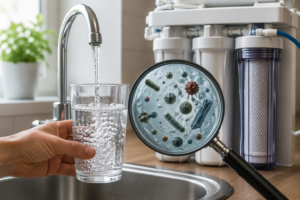
Turn the faucet and – voilà! – water magically tumbles out on demand. But don’t be fooled by the effortless flow – your tap water’s had more adventures than most reality TV stars. Before it arrives at your kitchen, it’s trekked from rivers, reservoirs, treatment plants, and, of course, that fabulous maze of ancient underground pipes.
While public water systems do their best to pass inspection, let’s just say your water sometimes picks up some uninvited road trip companions. These tagalongs might be subtle, but savvy homeowners are beginning to wonder what really ends up in their glass. Welcome to the underappreciated world of hidden water hitchhikers – discovering (and ousting) them is your ticket to both cleaner water and a happier home investment!
Identifying Common Contaminants in Tap Water
Even the squeaky-clean water from municipal treatment can sneak a few unwanted souvenirs past the doorman. Heavy metals like lead and copper are notorious for leaping in from elderly plumbing pipes, making your water’s journey more “Indiana Jones” than you’d like. Chlorine, the official bouncer for dangerous bacteria, can stick around and give your H₂O that charming “swimming pool chic” aroma and taste.
And for those who enjoy plot twists, microplastics have joined the cast. These tiny plastic bits, broken off from larger litter, are escaping public filters nationwide – imagine confetti you never wanted at your kitchen party. Pinpointing which of these surprise guests have RSVP’d to your plumbing is the first – and smartest – move toward picking a filter that actually works.
Comparing Popular Filtration Methods
Not all contaminants are created equal, so playing matchmaker between pollutants and purifiers is essential. Let’s meet the two filtration heavyweights for your home: activated carbon filters and reverse osmosis systems. But before that, do refrigerator filters remove fluoride? This is a common question, and the answer is that they generally don’t because they tend to use activated carbon.
Activated Carbon Filters
Think of activated carbon like a super-spongy bouncer at your club. As water strolls through, the carbon grabs a hold of chemical riffraff, especially chlorine, funky-smelling organics, and just about anything that would ruin a gourmet glass of water. Easy to tuck underneath your counter and gentle on your wallet – these filters are solid wingmen against everyday H₂O annoyances.
Reverse Osmosis Systems
If activated carbon is your trusty bouncer, reverse osmosis (RO) is the velvet-rope VIP security guard. This system hustles water through a semipermeable membrane, denying entry to anything larger than, well, a water molecule. Heavy metals? Denied. Fluoride? Nope. Even some stubborn dissolved solids get the boot. It’s the gold standard for purity snobs, though beware: between the higher price and extra plumbing space, RO is more commitment than your average water filter fling.
Practical Tips for Choosing the Right System
Choosing your water guardian depends on what’s actually splashing out of your tap. Grab your latest water report from the city, or channel your inner detective with an at-home test kit. If the air in your kitchen screams “pool day,” a simple under-sink carbon filter may be the only hero you need. Spotting extra lead or a sky-high count of dissolved solids on your report? Time to power up to a reverse osmosis system.
You’ll also need to decide if you want to purify every drop with a whole-house system – keeping pipes and appliances scale-free – or focus all your energy on your drinking water with a single-faucet (point-of-use) solution. Don’t skip the fine print on ongoing maintenance; the best filter in the world won’t help if you forget to change it out on schedule.
Take Control of Your Family’s Hydration Safety
Taking charge of your water is a stellar act of homeownership. When you know what’s in your stream and choose the right gear, you’re not just improving Wednesday’s spaghetti – you’re protecting your pipes, your appliances, and your family’s peace of mind. You’ve invested plenty in making your home a castle. Ensuring that the moat (or at least the kitchen tap) is stocked with clean, fresh water? That’s the kind of smart move every ruler can raise a glass to!