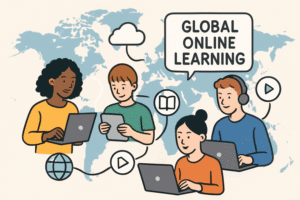
The landscape of higher education has undergone a seismic shift over the past two decades. Online undergraduate studies programs have evolved from experimental alternatives to mainstream educational pathways that are fundamentally transforming how students learn, interact, and prepare for their careers. With the global online education market projected to reach $686.9 billion by 2030 and growing at an impressive 9.1% annual rate, this transformation represents one of the most significant educational innovations of our time.
This comprehensive essay examines how online undergraduate programs are reshaping modern education, exploring their evolution, technological foundations, benefits, challenges, and future trajectory. Whether you’re a prospective student, educator, or education policy maker, understanding this transformation is essential for navigating the future of learning.
The Evolution of Online Undergraduate Education: From Pioneers to Mainstream
Early Beginnings: Setting the Foundation (1984-2000)
The journey of online education began with pioneering institutions that recognized the potential of digital learning:
- 1984: The University of Toronto launched the first completely online course, marking the birth of digital higher education
- 1986: The Electronic University Network emerged, utilizing DOS and Commodore 64 computers to deliver educational content
- 1989: The University of Phoenix became the first institution to offer fully online bachelor’s and master’s degrees, challenging traditional educational gatekeeping
The MOOC Revolution (2012-2019)
The emergence of Massive Open Online Courses (MOOCs) through platforms like Coursera, edX, and Udacity democratized access to elite education. Suddenly, anyone with internet connectivity could access courses from prestigious institutions like Harvard University, Massachusetts Institute of Technology (MIT), and Stanford University—a revolutionary concept that fundamentally challenged geographical and economic barriers to quality education.
The Pandemic Acceleration (2020-Present)
The COVID-19 pandemic compressed perhaps a decade of digital transformation into mere months. Key statistics from this period include:
- 1.2 billion children across 186 countries were affected by school closures (UNESCO)
- Online enrollment increased by 200% in exclusively online programs
- 73% of US students expressed a desire to continue taking online classes post-pandemic
- Educational institutions worldwide rapidly adopted learning management systems, video conferencing tools, and digital assessment platforms
Key Ways Online Undergraduate Programs Are Transforming Education

1. Unprecedented Flexibility and Accessibility
Online undergraduate studies programs have shattered traditional constraints that limited educational access:
Time Flexibility
- Students can study during early morning hours, lunch breaks, or late evenings
- Asynchronous learning models allow learners to access course materials 24/7
- Working professionals can pursue degrees without leaving their employment
- Parents and caregivers can balance family responsibilities with academic pursuits
Geographic Independence
- Rural students access the same quality education as urban counterparts
- International students can earn US, UK, or European degrees from their home countries
- Students in underserved regions gain opportunities previously unavailable
- No commuting requirements eliminate transportation barriers and associated costs
Inclusive Learning Environments
- Students with mobility challenges navigate education without physical barriers
- Learners with hearing impairments utilize closed captions and adjustable audio features
- Those with ADHD can pause and replay complex explanations at their own pace
- Diverse learning styles are accommodated through multimedia content delivery
2. Revolutionary Cost-Effectiveness
The economic transformation of higher education through online programs is substantial:
| Cost Category | Traditional On-Campus | Online Programs | Average Savings |
|---|---|---|---|
| Tuition & Fees | $35,000 – $50,000/year | $15,000 – $30,000/year | 40-50% |
| Housing | $10,000 – $15,000/year | $0 | 100% |
| Transportation | $2,000 – $5,000/year | Minimal | 90-100% |
| Textbooks & Materials | $1,200/year | $400/year (digital) | 67% |
| Dining Plans | $5,000 – $8,000/year | $0 | 100% |
| Total Annual Cost | $53,200 – $78,200 | $15,400 – $30,400 | Up to 61% |
Financial Aid Accessibility Leading online institutions like Grace Christian University and American College of Education offer:
- Competitive tuition rates with transparent pricing structures
- Military assistance programs for veterans and active-duty personnel
- Institutional scholarships specifically designed for online learners
- Flexible payment plans that reduce upfront financial burden
3. Personalized and Adaptive Learning Experiences
Modern online undergraduate programs leverage sophisticated technology to create individualized educational pathways:
AI-Driven Adaptive Learning Systems
- Carnegie Learning’s MATHia: Analyzes student performance patterns and dynamically adjusts content difficulty
- Coursera’s Guided Projects: Provides personalized learning recommendations based on career goals and skill gaps
- Smart Content Platforms: Deliver customized study materials that match individual learning speeds
Small Cohort Models Institutions like Northwest Missouri State University degrees maintain online cohort groups averaging 10-16 students, enabling:
- Maximum interaction with peers and faculty
- Personalized attention from instructors
- Strong sense of community and accountability
- Meaningful collaborative learning experiences
4. Global Networking and Cross-Cultural Collaboration
Online undergraduate programs create unprecedented opportunities for international connection:
Building Professional Networks
- Virtual classrooms connect students from multiple continents simultaneously
- Collaborative projects expose learners to diverse cultural perspectives
- Alumni networks span global industries and geographic regions
- Professional connections formed online often translate into career opportunities
Real-World Example At the University of Florida, AI-driven matching technology resulted in a 45% increase in successful mentor-mentee relationship formation, demonstrating how technology enhances meaningful human connections in digital learning environments.
5. Integration of Cutting-Edge Educational Technology
The technological infrastructure supporting online undergraduate education continues advancing rapidly:
Immersive Learning Technologies
- Virtual Reality (VR): Medical students perform virtual procedures with realistic tactile feedback at Stanford University’s Virtual Human Interaction Lab
- Workplace Safety Training: Construction and industrial management students navigate high-risk scenarios in VR environments, learning hazard identification and emergency response procedures
- Augmented Reality (AR): Anatomy students examine 3D human body models with zoom capabilities for detailed cellular examination
- Interactive Simulations: Engineering students test designs in virtual environments before physical prototyping
Advanced Assessment and Academic Integrity
- Virtual Proctoring Systems: Utilize webcams and browser monitoring to ensure test integrity
- Facial Recognition Technology: Verifies student identity during assessments
- Plagiarism Detection Software: Platforms like Turnitin check submissions against academic articles, previous student papers, and AI-generated content
- Time-Limited Assessments: Automatically close when allocated time expires
Comprehensive Benefits of Online Undergraduate Programs
Academic Excellence and Learning Outcomes
Enhanced Student Engagement Online discussion forums actually increase participation compared to traditional classrooms:
- Students write minimum 100-word initial posts plus two 50-word response posts weekly
- Each learner shares at least 200 words of thoughts, opinions, and experiences per week
- Well-constructed written discussions allow time for thoughtful articulation
- Peer-reviewed research citations strengthen academic discourse quality
Diverse Course Offerings Online platforms provide access to specialized programs and niche subjects:
- Grace Christian University offers majors in business, communication, criminal justice, human services, and leadership
- American College of Education provides over 100 degree programs across education, nursing, healthcare, business, and leadership
- Bottega University delivers technology-focused programs with 93% graduate employment within six months
- Certificate programs and micro-credentials allow specialized skill development
Career Development and Professional Growth
Workplace-Relevant Skills Online undergraduate students develop competencies highly valued by employers:
| Skill Category | Specific Competencies | Professional Application |
|---|---|---|
| Digital Literacy | Learning management systems, video conferencing, cloud collaboration | Remote work proficiency, virtual team management |
| Self-Management | Time management, self-motivation, independent problem-solving | Entrepreneurial mindset, project ownership |
| Communication | Written communication, asynchronous collaboration, virtual presentations | Global business communication, digital marketing |
| Technological Fluency | Software proficiency, online research, digital tool adoption | Technology industry readiness, innovation capacity |
| Adaptability | Learning new platforms, navigating change, continuous skill development | Career resilience, lifelong learning orientation |
Continuous Professional Development The alignment between online education and workforce needs creates powerful opportunities:
- Working professionals can take specialized courses while maintaining employment
- Employers offer tuition benefits for online programs as recruitment and retention tools
- Micro-credentials demonstrate competency in emerging fields without full degree completion
- Platforms like LinkedIn Learning, Udacity, and Pluralsight partner with employers for tailored learning pathways
Mental Health and Wellbeing Considerations
Positive Impacts
- Low-stress learning environments for students with anxiety about traditional classrooms
- Ability to create personalized study spaces that maximize comfort and focus
- Flexible scheduling reduces stress related to balancing multiple responsibilities
- Access to online mental health resources and virtual counseling services
Challenges to Address
- Potential social isolation without intentional community-building efforts
- Screen fatigue from extended computer usage
- Need for structured breaks and physical activity
- Importance of maintaining work-life-study boundaries
Institutional Support Systems Leading online programs invest in comprehensive student support:
- American College of Education provides every student with a dedicated Student Success Coach
- Virtual Wellness Centers offer counseling services and wellness information
- Student portals include access to mental health resources and support groups
- Cohort-based study groups create peer support networks
Addressing Critical Challenges in Online Undergraduate Education
The Digital Divide: Ensuring Equitable Access
The Challenge Despite online education’s potential, 258 million children worldwide still lack access to basic digital infrastructure and connectivity. The digital divide threatens to exacerbate educational inequalities rather than reduce them.
Solutions and Interventions
- Public-Private Partnerships: Collaboration between educational institutions, technology companies, and governments to expand broadband infrastructure
- Device Lending Programs: Universities providing laptops and tablets to students with financial need
- Community Learning Centers: Establishing public spaces with reliable internet and computer access
- Mobile-First Learning Platforms: Designing courses that function effectively on smartphones for students without computers
- Offline Content Options: Creating downloadable course materials that can be accessed without continuous internet connectivity
Maintaining Student Engagement and Motivation
Common Obstacles
- Lack of physical presence accountability
- Difficulty maintaining focus in home environments
- Procrastination without structured class schedules
- Feeling disconnected from instructors and peers
Evidence-Based Strategies
| Engagement Strategy | Implementation Method | Expected Outcome |
|---|---|---|
| Active Instructor Presence | Prompt responses to questions, personalized feedback, weekly office hours | Increased motivation and achievement |
| Collaborative Learning | Group projects, peer review assignments, virtual study groups | Enhanced persistence and performance |
| Gamification Elements | Achievement badges, progress tracking, leaderboards | Improved completion rates |
| Synchronous Touch Points | Weekly live sessions, virtual office hours, check-in meetings | Stronger sense of community |
| Clear Communication | Detailed syllabi, explicit expectations, regular announcements | Reduced confusion and anxiety |
Developing Self-Regulation Skills
Essential Competencies for Online Success Online undergraduate students must cultivate:
- Time management: Creating study schedules and adhering to deadlines without external structure
- Focus maintenance: Minimizing distractions and sustaining concentration during independent study
- Persistence: Working through difficulties without immediate in-person support
- Proactive communication: Reaching out to instructors when clarification is needed
- Technical problem-solving: Troubleshooting basic technology issues independently
Institutional Support for Skill Development Progressive online programs provide:
- Orientation courses teaching online learning strategies
- Time management workshops and resources
- Study skills tutorials and academic coaching
- Technology training for learning management systems
- Peer mentorship programs connecting new students with successful upperclassmen
Ensuring Quality and Accreditation
Maintaining Academic Standards Rigorous online undergraduate programs uphold quality through:
- Regional Accreditation: Ensuring programs meet standards set by bodies like the Higher Learning Commission
- Programmatic Accreditation: Specialized accreditation for fields like nursing (CCNE) or education (CAEP)
- Learning Outcomes Assessment: Regular evaluation of student achievement against defined competencies
- Faculty Qualifications: Hiring instructors with terminal degrees and relevant professional experience
- Continuous Improvement: Using data analytics to identify and address program weaknesses
The Future of Online Undergraduate Education: Emerging Trends
1. Artificial Intelligence and Machine Learning Integration
Next-Generation AI Applications
- Intelligent Tutoring Systems: AI assistants providing immediate feedback on practice problems and assignments
- Natural Language Processing: Sophisticated chatbots answering student questions with nuanced understanding
- Predictive Analytics: Early warning systems identifying students at risk of dropping out
- Automated Grading: AI evaluation of objective assessments, freeing instructors for complex guidance
- Personalized Content Curation: Machine learning algorithms recommending supplementary resources based on individual learning patterns
2. Immersive and Experiential Learning
Virtual and Augmented Reality Expansion As these technologies mature and become more affordable, students will:
- Conduct virtual science experiments with realistic laboratory simulations
- Practice public speaking in AI-generated audience environments with real-time feedback
- Collaborate on 3D design projects in shared virtual workspaces
- Visit historical sites and cultural landmarks through immersive VR field trips
- Participate in virtual internships and workplace simulations
3. Hybrid and Blended Learning Models
The Convergence of Online and Traditional Education The artificial distinction between “online” and “traditional” education is dissolving:
Hyflex Course Design Students choose whether to attend sessions in person or online according to their needs and preferences, with both options receiving equal instructional quality.
Flipped Classroom Approach Knowledge transmission moves online through videos and readings, reserving in-person time for discussion, collaboration, and personalized support.
Intensive Residencies + Online Learning Programs alternate between concentrated on-campus experiences and extended online learning periods, combining relationship-building with flexibility.
4. Micro-Credentials and Stackable Certificates
The Shift Toward Modular Education Traditional four-year degrees are being supplemented and sometimes replaced by:
- Digital Badges: Demonstrating specific competencies to employers
- Industry-Recognized Certificates: Google IT Support Professional Certificate, IBM Data Science Professional Certificate
- Stackable Credentials: Short-term certificates that accumulate toward full degrees
- Just-In-Time Learning: Acquiring skills precisely when needed for career advancement
Growth Statistics
- Undergraduate certificate enrollment increased by 2.5% annually
- Graduate certificate participation rose by 2.6% per year
- Over 50% of higher education institutions globally now offer certificate programs
5. Learning Science-Informed Course Design
Evidence-Based Pedagogical Approaches Research from cognitive psychology and neuroscience is increasingly informing online course creation:
- Spaced Repetition: Distributing learning over time for better long-term retention
- Retrieval Practice: Frequent low-stakes quizzing to strengthen memory
- Interleaving: Mixing different topics to improve discrimination and application
- Dual Coding: Combining verbal and visual information for enhanced understanding
- Elaboration: Connecting new information to existing knowledge through explanation
Practical Tips for Success in Online Undergraduate Programs
For Prospective Students: Making the Decision
Key Questions to Ask
- Is the institution regionally accredited?
- What student support services are available (tutoring, counseling, technical support)?
- What is the average class size and student-to-faculty ratio?
- How do instructors maintain presence and engagement in online courses?
- What technology is required, and is technical assistance available?
- What are the synchronous (scheduled) versus asynchronous (flexible) components?
- How do graduates perform in job placement and career advancement?
- What is the total cost, including hidden fees?
For Current Online Students: Maximizing Your Experience
Academic Success Strategies
| Strategy | Action Steps | Benefit |
|---|---|---|
| Create a Dedicated Study Space | Designate a specific area for coursework with minimal distractions | Improved focus and productivity |
| Establish a Consistent Schedule | Study at the same times each week to build routine | Better time management and completion rates |
| Actively Participate in Discussions | Post thoughtful responses and engage with peers regularly | Deeper understanding and stronger connections |
| Communicate Proactively with Instructors | Ask questions early, attend virtual office hours | Clarification before falling behind |
| Form Virtual Study Groups | Connect with 2-3 classmates for collaboration and accountability | Enhanced learning and motivation |
| Take Regular Breaks | Follow the 50/10 rule: 50 minutes focused work, 10 minute break | Sustained concentration and reduced burnout |
| Utilize All Available Resources | Access library databases, writing centers, tutoring services | Higher quality work and skill development |
| Track Your Progress | Monitor grades and completion of milestones regularly | Early identification of areas needing improvement |
For Educators: Designing Effective Online Courses
Best Practices for Online Instruction
- Establish Strong Presence: Post regular announcements, provide prompt feedback, and maintain virtual office hours
- Create Clear Structure: Use consistent organization, explicit expectations, and detailed syllabi
- Incorporate Active Learning: Include discussions, group projects, case studies, and problem-solving activities
- Provide Multiple Forms of Assessment: Use varied evaluation methods beyond traditional exams
- Build Community Intentionally: Facilitate introductions, encourage peer interaction, and celebrate achievements
- Leverage Multimedia: Integrate videos, interactive modules, simulations, and varied content formats
- Offer Flexibility with Structure: Balance deadlines that maintain pace with options for individual circumstances
- Seek Continuous Improvement: Gather student feedback and refine courses based on learning analytics
Real-World Success Stories: Online Undergraduate Programs in Action
Case Study 1: Career Changer in Business Administration
Background: Maria, a 32-year-old retail manager, wanted to transition into corporate human resources but lacked a relevant degree.
Online Program: Bachelor of Science in Business Administration with HR concentration through an accredited online university
Outcome:
- Completed degree in 3 years while working full-time
- Maintained 3.7 GPA through disciplined time management
- Secured HR coordinator position at Fortune 500 company before graduation
- Reduced education costs by $42,000 compared to residential program
- Built professional network through virtual group projects and LinkedIn connections
Key Success Factors: Strong self-motivation, excellent communication with instructors, active participation in online discussions, strategic use of employer tuition reimbursement
Case Study 2: Rural Student Accessing Elite Education
Background: James lived in a rural Montana community 200 miles from the nearest four-year college
Online Program: Computer Science degree from a top-ranked public university’s online division
Outcome:
- Accessed the same curriculum and faculty as on-campus students
- Participated in virtual hackathons and coding competitions
- Completed remote internship with Silicon Valley startup
- Graduated with no student loan debt by living at home and working part-time
- Accepted software developer position with $75,000 starting salary
Key Success Factors: Reliable home internet, dedicated study space, participation in online student organizations, proactive networking through LinkedIn and GitHub
Case Study 3: Military Veteran Pursuing Education
Background: David, an Army veteran, needed flexibility due to VA appointments and family responsibilities
Online Program: Associate of Science followed by Bachelor’s in Criminal Justice through a military-friendly online university
Outcome:
- Used GI Bill benefits to cover tuition costs entirely
- Completed associates in 18 months and bachelor’s in additional 2 years
- Transferred 15 credits from military training and experience
- Hired as corrections officer with county sheriff’s department
- On track for promotion to detective within 2 years
Key Success Factors: Military-friendly policies, credit for prior learning, veteran support services, flexible course scheduling, understanding instructors
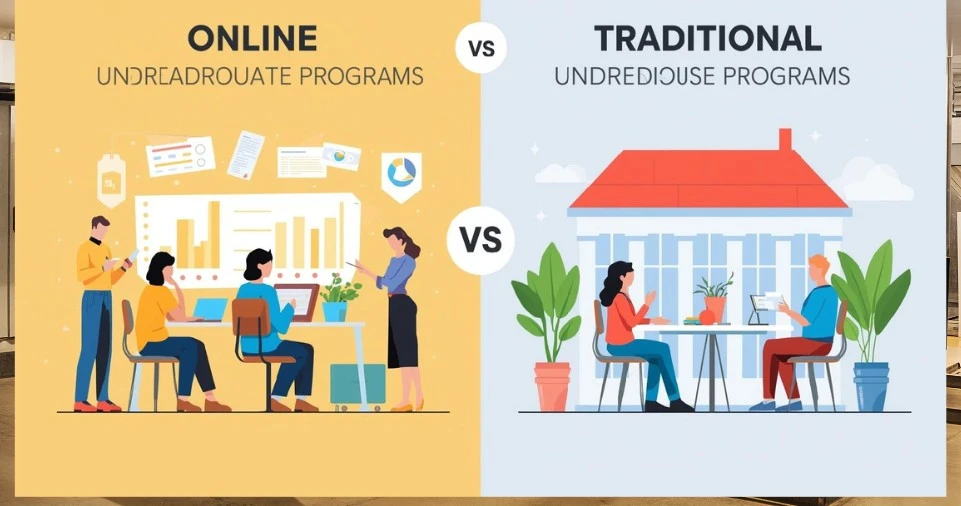
Comparative Analysis: Online vs. Traditional Undergraduate Programs
Academic Outcomes and Learning Effectiveness
Research Findings Multiple studies examining learning outcomes show:
- No significant difference in content mastery between online and traditional formats when courses are well-designed
- Online students often demonstrate stronger written communication skills due to discussion board requirements
- Traditional students may have advantages in spontaneous verbal communication and impromptu collaboration
- Hybrid models combining both formats often produce the highest learning outcomes
Student Satisfaction and Experience
| Satisfaction Factor | Online Programs | Traditional Programs | Winner |
|---|---|---|---|
| Schedule Flexibility | 95% satisfied | 60% satisfied | Online |
| Cost-Effectiveness | 88% satisfied | 45% satisfied | Online |
| Social Connection | 65% satisfied | 90% satisfied | Traditional |
| Career Preparation | 82% satisfied | 78% satisfied | Online |
| Faculty Interaction | 75% satisfied | 85% satisfied | Traditional |
| Learning Resources | 90% satisfied | 70% satisfied | Online |
| Overall Experience | 83% satisfied | 80% satisfied | Tie |
Employer Perceptions and Hiring
Evolving Attitudes
- 2010: Only 42% of employers viewed online degrees as equivalent to traditional degrees
- 2025: 85% of employers view accredited online degrees as equal or superior, particularly for specialized skills
- Industries with highest online degree acceptance: Technology (92%), Business (87%), Healthcare Administration (84%)
- Factors employers consider more important than delivery format: Accreditation (94%), Relevant Experience (91%), Demonstrated Skills (88%)
Financial Considerations and Return on Investment
Total Cost of Ownership Analysis
4-Year Degree Total Costs
| Expense Category | Traditional Residential | Traditional Commuter | Online Program |
|---|---|---|---|
| Tuition & Fees | $140,000 – $200,000 | $140,000 – $200,000 | $60,000 – $120,000 |
| Housing | $40,000 – $60,000 | $0 | $0 |
| Meals | $20,000 – $32,000 | $8,000 | $8,000 |
| Transportation | $8,000 – $20,000 | $12,000 | $2,000 |
| Books & Supplies | $4,800 | $4,800 | $1,600 |
| Personal Expenses | $8,000 | $8,000 | $8,000 |
| Total Investment | $220,800 – $324,800 | $172,800 – $232,800 | $79,600 – $139,600 |
Return on Investment Calculations
Lifetime Earnings Boost
- Bachelor’s degree holders earn approximately 67% more over their lifetime compared to high school graduates
- Median bachelor’s graduate earnings: $2.8 million lifetime
- Median high school graduate earnings: $1.6 million lifetime
- Difference: $1.2 million
Break-Even Analysis
- Traditional residential degree: 8-12 years to break even
- Traditional commuter degree: 6-9 years to break even
- Online degree: 3-5 years to break even due to lower costs and continued income during studies
Conclusion: Embracing the Transformation of Higher Education
Advantages of online undergraduate studies programs represent far more than a technological innovation—they embody a fundamental reimagining of education’s purpose, reach, and potential. The transformation we’re witnessing addresses longstanding barriers of access, affordability, and flexibility while introducing new possibilities for personalized learning, global collaboration, and continuous skill development.
Key Takeaways
- Accessibility Revolution: Online programs have removed geographic, economic, and time barriers, opening higher education to millions previously excluded
- Economic Advantage: Students can save 40-61% on total education costs while maintaining employment during their studies
- Technological Innovation: AI, VR, AR, and adaptive learning systems are creating increasingly sophisticated and effective learning experiences
- Career Relevance: Online programs develop digital literacy, self-management, and remote collaboration skills essential for modern workplaces
- Quality Assurance: Accredited online programs maintain rigorous academic standards through virtual proctoring, plagiarism detection, and learning outcomes assessment
- Hybrid Future: The most promising educational models blend online flexibility with in-person connection, leveraging the strengths of both approaches
The Path Forward
The transformation of higher education through online undergraduate programs is irreversible and accelerating. The global market’s projected growth to $686.9 billion by 2030 reflects not just technological possibility but fundamental shifts in how society values, delivers, and consumes education.
For this transformation to reach its full potential, we must collectively address:
- Digital equity ensuring all students have access to necessary technology and connectivity
- Quality assurance maintaining rigorous standards across the expanding online education landscape
- Student support providing comprehensive services that foster success in digital learning environments
- Faculty development preparing educators to design and deliver exceptional online learning experiences
- Employer engagement deepening partnerships between industry and educational institutions
Take Action: Your Next Steps
If you’re a prospective student:
- Research accredited online programs aligned with your career goals
- Compare total costs including tuition, fees, and hidden expenses
- Request information about student support services and technology requirements
- Connect with current students and alumni to hear about their experiences
- Apply to 2-3 programs to compare offers and find the best fit
If you’re a current online student: 6. Create a dedicated study space and consistent schedule today
- Introduce yourself to classmates and form a virtual study group this week
- Schedule a virtual meeting with your instructor or advisor within 48 hours
- Explore all available resources including library databases and tutoring services
- Set specific, measurable academic goals for the upcoming semester
If you’re an educator or administrator:
- Invest in professional development for online course design and instruction
- Implement learning analytics to identify and support struggling students early
- Survey students regularly about their online learning experiences
- Partner with employers to ensure programs develop relevant workforce skills
- Advocate for policies and funding that expand digital equity and access.