
Key Takeaways
- An MBA in Business Analytics equips professionals with the skills to turn data into actionable insights, combining technical expertise with strategic thinking.
- Graduates are prepared for diverse roles, including Business Analyst, Data Scientist, Marketing Analyst, Operations Analyst, Financial Analyst, Product Manager, Consultant, and Chief Data Officer.
- Strong analytical, problem-solving, and communication skills are critical for bridging the gap between data and business decisions.
- The degree fosters leadership and strategic decision-making abilities, positioning graduates to drive organizational growth and innovation.
- Industries such as finance, healthcare, retail, technology, and manufacturing highly value professionals who can interpret complex data to inform strategy.
- Careers in business analytics are dynamic, in-demand, and offer opportunities to influence decisions, optimize processes, and guide digital transformation.
Introduction
In today’s data-driven economy, the ability to make informed decisions quickly and accurately is critical for any organization aiming to maintain a competitive edge. Business analytics stands at the intersection of data science and strategic management, enabling professionals to turn raw data into business insights that drive value. Earning an online MBA Business Analytics equips students with the analytical prowess and business acumen necessary to excel in a variety of roles where data and strategy converge.
Organizations across industries are seeking individuals who can bridge the gap between vast data streams and actionable business insights. This unique blend of skills not only supports business growth but also personal career advancement. As businesses prioritize data-informed decisions, professionals with an MBA in Business Analytics have a significant advantage in the market.
The combination of technical competence, strategic thinking, and leadership fostered by an MBA in Business Analytics creates opportunities in sectors that rely on analytics to shape their future direction. These industries include finance, healthcare, retail, technology, and manufacturing, all of which depend on strong data interpretation for daily operations and long-term strategy.
Besides opening doors to traditional analyst roles, this degree propels graduates into leadership, consultancy, and operations roles, all centered on leveraging data to solve complex problems and create value. According to Harvard Business Review, organizations with advanced analytics talent outperform competitors and are quicker to innovate.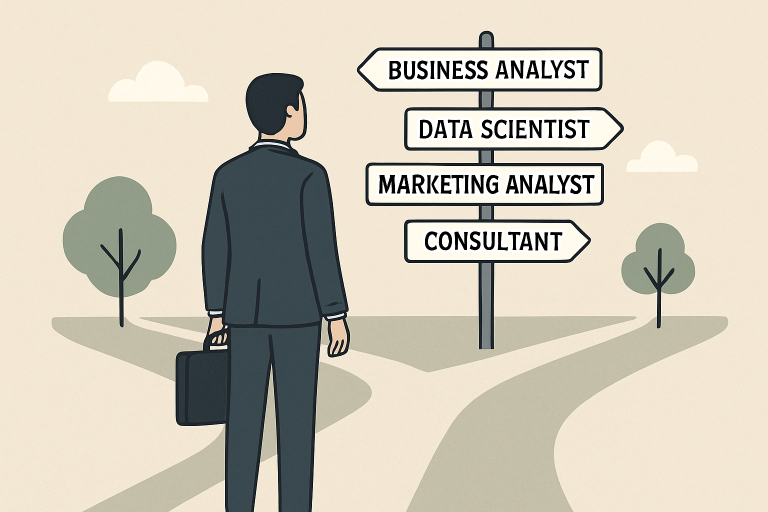
Business Analyst
A Business Analyst serves as the bridge between organizational goals and the technical teams that develop solutions. These professionals analyze business processes, gather requirements, interpret data patterns, and recommend business strategies. Industries such as finance, healthcare, and retail rely on Business Analysts to identify ways to increase efficiency, reduce costs, and boost revenues. Effective Business Analysts turn raw data into actionable plans that drive measurable business improvements.
Data Scientist
Data Scientists blend mathematics, programming, and business sense to extract insights from massive datasets. They employ machine learning, statistical modeling, and data visualization to anticipate market trends and guide high-level decision-making. Technology, e-commerce, and banking are among the sectors investing in data science for customer analytics, fraud detection, inventory forecasting, and more. As the volume and complexity of data grow, the demand for skilled Data Scientists continues to surge.
Marketing Analyst
Marketing Analysts help companies understand consumer behaviors and preferences by mining customer data, monitoring campaign performance, and evaluating ROI. They support campaign targeting, segmentation, and product development efforts. As companies across advertising, fast-moving consumer goods, and digital marketing focus on personalization at scale, Marketing Analysts help ensure resources are allocated for maximum engagement and conversion.
Operations Analyst
Operations Analysts work to streamline business processes, cut inefficiencies, and improve overall productivity. An MBA in Business Analytics in Northwest Missouri State University equips students with the tools to analyze workflow data, identify bottlenecks, and recommend process redesigns. In industries such as manufacturing, transportation, and logistics, these professionals are instrumental in optimizing supply chains, improving inventory management, and increasing throughput.
Financial Analyst
Financial Analysts use their quantitative skills to evaluate investment opportunities, assess risk, and support financial planning. With an MBA in Business Analytics, they can develop advanced forecasting models and interpret market trends for investment banking, corporate finance, and asset management firms. Employers value analysts who can clearly communicate financial risks and growth opportunities grounded in robust data analysis.
Product Manager
Product Managers coordinate the design, development, and marketing of products by making data-driven recommendations about features, pricing, and positioning. Business analytics expertise helps these professionals quickly adapt to changing market needs and competitive landscapes. Today, companies across tech, manufacturing, and consumer goods are actively seeking Product Managers who treat data as a core asset in the innovation process.
Consultant
Consultants harness data analytics to guide client organizations through strategic change, digital transformation, and performance improvement. Consulting roles require strong interpersonal and communication skills, as well as deep analytical capabilities. Firms specializing in management, IT, and boutique data services seek MBA grads with analytical backgrounds to craft bespoke solutions and maximize client outcomes.
Chief Data Officer (CDO)
The Chief Data Officer holds a leadership role, overseeing the entire data strategy of an organization, including data governance, quality, and compliance. CDOs help shape how businesses capture, store, and leverage data to gain a competitive advantage. As companies recognize the importance of data across every part of their operations, the position of CDO has become essential for those seeking to lead in digital innovation and a data-driven culture.
Final Thoughts
An MBA in Business Analytics paves the way for dynamic and rewarding careers as businesses across the globe embrace analytics as a core driver for growth. Professionals who can interpret complex datasets, translate findings into actionable business strategies, and communicate insights effectively will continue to be in high demand. As the world of business becomes increasingly dependent on data, those who possess these advanced skills will play a critical role in shaping the future of their organizations and industries.