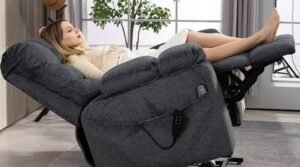
A chair gets measured against the wall it will sit near, delivered, positioned, and then discovered to be unusable in that spot. Not because the measurement was wrong, but because the measurement described the chair standing still, and the chair does not stay still. It moves backward when someone leans into it, and the space it needs at that moment is somewhere else entirely.
Reclining furniture occupies two footprints. Nearly every product listing describes one of them.
Upright Dimensions Describe a Chair Nobody Uses
Published measurements state width, depth, and height in the closed position. Those numbers determine whether a chair fits through a doorway and how much floor it covers when the room is empty.
They say very little about how the chair functions, because a reclining chair spends its useful life somewhere other than upright. The relevant dimension is the depth at full recline, which on many designs exceeds the closed depth by eight to fourteen inches, and on some considerably more.
That difference falls entirely behind the chair. A model measured at thirty-six inches deep and placed thirty-eight inches from a wall will contact the wall partway through its travel, and the person sitting in it will feel the chair stop moving before it has finished reclining. The chair is not broken. It ran out of room.
The Mechanism Determines Where the Space Goes
Different reclining designs distribute their movement differently, and the distinction is more consequential than the visual difference between them suggests.
A conventional recliner rotates the seat back around a pivot near the base, which swings the top of the backrest rearward through an arc. The clearance requirement grows through the full range of travel, and the deepest point coincides with the most reclined position.
A tilt mechanism moves the entire seat and back as a unit, pivoting around a point beneath the seat. The back still travels rearward, but the geometry differs, and the seat front rises as the back drops. Wall clearance is still required, though the relationship between recline angle and rear clearance is not the same.
Wall-proximity designs use a track that carries the seat forward as the back reclines, holding the back roughly in place. These allow placement within a few inches of a wall, at the cost of requiring clearance in front instead, which matters in a narrow room where a coffee table sits opposite.
Separate Ottomans Change the Calculation
Chairs paired with a separate ottoman rather than a built-in footrest behave differently again, and the difference works in both directions.
The chair itself is generally shallower, since there is no internal footrest mechanism to house. That reduces the closed footprint. But the ottoman occupies its own floor space, positioned forward of the chair at a distance determined by leg length rather than by design, and the combined depth of chair plus gap plus ottoman frequently exceeds what a single integrated unit would require.
The advantage is that the two pieces can be separated. The ottoman moves aside when the room is being used differently, gets pulled closer or pushed further depending on who is sitting, and functions independently as a surface or additional seat. A tilt back chair with ottoman therefore trades a larger combined footprint for the ability to reconfigure it, which suits rooms that serve more than one purpose.
Traffic Paths Are Not Negotiable
Furniture planning frequently treats floor space as available if nothing is standing on it. Circulation routes do not work that way.
A primary walking path through a room needs roughly thirty-six inches of clear width to function comfortably. Secondary routes can compress toward thirty. Below that, people begin turning sideways, and a route people avoid stops being a route, which redistributes movement through the rest of the room in ways that are difficult to predict from a floor plan.
A reclining chair intersects this in a specific way. The chair may sit clear of a walking path when upright and extend into it when reclined. The path is available exactly when nobody is using the chair and blocked whenever someone is, which is the opposite of useful.
Doorway swing arcs, drawer and cabinet extensions, and window treatments that operate downward all create similar conflicts that a plan view of the room does not show.
Seat Height Governs Getting Up
Recline comfort receives most of the attention, though the more frequently encountered problem is exit.
Seat height from the floor determines how much work standing up requires. Lower seats feel more relaxed and demand more effort to leave, since the legs must lift the body through a greater distance. Deeply reclined positions compound this by placing the body further from the position it needs to reach.
Arm height and structure matter as well. Arms at a usable height give hands something to push against, and the difference between an arm that supports body weight and one that does not is substantial for anyone with limited strength in the legs.
These factors do not appear in a showroom sit-down of thirty seconds. They emerge over months, and they determine whether a chair someone bought for comfort remains comfortable as circumstances change.
Testing Against the Actual Room
The gap between showroom impression and home performance is largely a measurement gap, and it closes with a short exercise before purchase.
Recording the reclined depth, not the upright depth, gives the number that matters. Marking that footprint on the floor with tape, including the arc the chair travels through, shows what it will actually occupy. Walking the room’s normal routes with the tape in place reveals conflicts that a tape measure and a floor plan will not.
Sitting long enough to stand up several times, from the fully reclined position rather than the upright one, tests the exit motion under the conditions it will occur in.
None of this takes long, and it resolves questions that are expensive to answer afterward. Reclining furniture is heavy, frequently difficult to return, and rarely improves through repositioning once the room has no better position to offer.