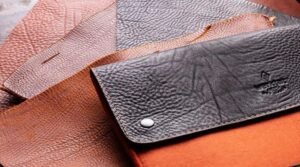
There is a distinct, tactile thrill that comes with handling premium, garment-weight leather. Whether it is a buttery Italian lambskin destined to become a luxury handbag or a soft, milled calfskin meant for a bespoke jacket, these materials possess a fluid, fabric-like drape. They are elegant, highly sought after by consumers, and absolutely miserable to work with on a mechanical level.
For a leatherworker accustomed to the rigid, predictable nature of heavy vegetable-tanned hides—the kind used for belts and saddles—transitioning to soft leather feels like trying to carve a block of warm gelatin. The material stretches, warps, and refuses to hold its shape under pressure. This frustrating reality becomes violently apparent during one of the most critical stages of high-end leathercraft: edge skiving.
To understand why thinning the edge of a soft hide so frequently ends in a chewed-up, ruined disaster, we have to look closely at the physics of a standard skiving machine and the “rubber band” effect of soft textiles.
The Architecture of the Folded Edge
In luxury leathercraft, raw, exposed edges are rarely acceptable on soft bags or garments. The standard finishing technique is the “turned edge,” where the perimeter of the leather is folded over onto itself and stitched down, creating a seamless, rolling boundary.
However, you cannot simply fold a piece of leather without creating massive, bulky seams. To achieve a sleek fold, the craftsman must drastically reduce the thickness of the leather precisely at the edge. They use a motorized skiving machine—a device featuring a rapidly spinning, razor-sharp steel cylinder known as a bell knife—to shave away a wedge of the material’s underside.
When feeding a firm piece of leather into a standard skiving machine, the process is smooth. A motorized stone roller on the bottom grabs the leather and pushes it forward into the spinning blade, while a stationary metal “presser foot” holds it down from the top. Because the firm leather has structural integrity, it slides under the stationary foot and through the blade with mathematical precision.
The “Rubber Band” Effect
The physics collapse entirely when you introduce a soft, stretchy leather to this standard mechanism.
The stationary metal presser foot resting on top of the leather relies on the material sliding smoothly beneath it. But soft, chrome-tanned leather has high surface friction and massive elasticity. As the bottom roller aggressively pushes the leather forward, the top of the leather drags and catches against the stationary metal foot.
Because the material is stretchy, it does not move forward at a uniform rate. Instead, it acts like a rubber band. The bottom layer is thrust into the spinning blade while the top layer is held back. The leather bunches up, stretches out of shape, and ultimately collapses into the bell knife. The result is a catastrophic jam. The edge is chewed into jagged, uneven strips, and an incredibly expensive piece of material is instantly ruined.
Engineering the Synchronization Solution
For decades, the only way to avoid this disaster was to manually thin soft edges by hand with a skiving knife—a slow, agonizing process prone to human error. However, industrial engineering eventually provided a brilliantly simple solution to the rubber band effect: if pushing from the bottom causes the material to stretch, you must also actively pull from the top.
This concept birthed the “top and bottom feed” mechanical system.
In these highly specialized machines, the stationary metal presser foot is entirely replaced. In its place is a second, motorized feeding mechanism that rests on top of the leather. This top feed is mechanically synchronized with the bottom feed roller. As the machine operates, both the top and the bottom mechanisms grab the leather simultaneously, pulling it through the spinning bell knife at the exact same speed.
Taming the Organic Variable
This synchronization fundamentally alters the physical dynamics of the cut. Because the leather is being actively transported from both sides, surface drag is completely eliminated. The material is not given the physical opportunity to stretch, bunch, or hesitate. It is marched through the razor-sharp blade in a perfectly flat, highly controlled state.
For artisans and mid-scale manufacturers, upgrading to a dual-feed system, such as the cobra np10 skiving machine, represents a fundamental shift in what materials they can reliably incorporate into their designs. It removes the anxiety of working with difficult, stretchy textiles and allows the craftsman to achieve the paper-thin, perfectly uniform edges required for world-class turned seams.
Ultimately, the mastery of leathercraft is not just about understanding how to cut a material; it is about understanding how to control it while it is being cut. By solving the physics of friction and stretch, modern feed mechanics allow the artisan to tame the most unpredictable hides on the market, transforming a chewed-up disaster into the invisible, flawless foundation of luxury design.