
Managing payroll is one of the most critical yet time-consuming responsibilities for small business owners. Between calculating wages, withholding taxes, ensuring compliance with ever-changing federal and state regulations, and meeting strict deadlines, the payroll process can quickly become overwhelming—especially for businesses with limited resources and staff.
According to recent industry data, approximately 45% of small businesses now choose to outsource their payroll and HR functions. This growing trend isn’t just about convenience; it’s a strategic decision that directly impacts a company’s bottom line, compliance status, and ability to focus on core business operations.
The average small business owner spends 5 to 7 hours per pay period managing payroll tasks. That’s over 100 hours annually dedicated solely to employment tax issues and payroll processing—time that could be invested in growing your business, serving customers, or developing new products and services.
In this comprehensive guide, we’ll explore the top reasons why small businesses are making the switch to outsourced payroll services, the tangible benefits they’re experiencing, and how you can determine if payroll outsourcing is the right move for your organization.
What is Payroll Outsourcing?
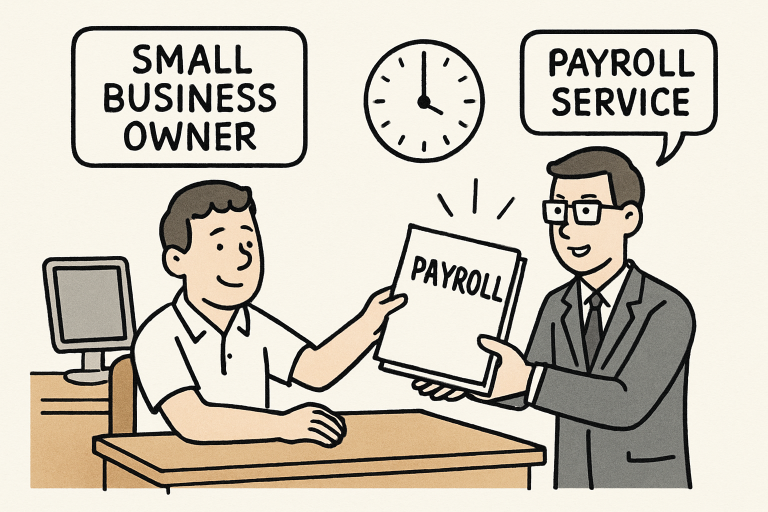
Payroll outsourcing involves delegating your payroll processing tasks to a specialized third-party provider instead of managing the entire process in-house. These providers are payroll experts who handle everything from calculating employee wages and managing tax withholdings to ensuring compliance with federal, state, and local tax laws.
Full vs. Partial Payroll Outsourcing
Small businesses have flexibility in how much they choose to outsource:
Full Payroll Outsourcing covers:
- Employee pay calculation (hourly wages, overtime, bonuses, commissions, salaries)
- Tax withholdings and filings (Form 941, W-2, W-3, quarterly returns)
- Direct deposits and paycheck distribution
- Employee benefits and deductions management
- Compliance monitoring and reporting
- Year-end tax form processing
Partial Payroll Outsourcing allows businesses to:
- Manage employee timesheets internally while outsourcing tax filings
- Handle direct deposits in-house but outsource compliance and reporting
- Process basic payroll calculations internally while outsourcing year-end W-2 processing
This flexible model enables businesses to balance cost savings with control, ensuring they only pay for the services they actually need.
Top 10 Reasons Small Businesses Outsource Payroll

1. Significant Time Savings
Time is your most valuable asset as a small business owner. Processing payroll in-house requires collecting timesheets, calculating wages, managing deductions, processing payments, and filing tax forms—tasks that consume 5-7 hours per pay period for the average small business.
By outsourcing payroll, you reclaim this valuable time and redirect it toward revenue-generating activities such as:
- Business development and sales
- Customer service and relationship building
- Product or service innovation
- Strategic planning and growth initiatives
- Employee engagement and team development
Real-World Impact: A 10-employee company processing bi-weekly payroll spends approximately 130 hours annually on payroll tasks. Outsourcing eliminates this burden, allowing owners to focus on activities that directly drive business growth.
2. Substantial Cost Reduction
While outsourcing involves an upfront investment, it typically costs less than managing payroll internally when you calculate the total cost of ownership.
Hidden Costs of In-House Payroll:
- Payroll software subscriptions and licensing fees
- Staff salaries and training expenses
- Time spent on payroll processing
- Compliance-related expenditures
- IRS penalties and fines for errors
- Administrative overhead
Average Outsourcing Costs:
- Base monthly fee: $30-$150
- Per-employee fee: $4-$12 per employee per month
- Total for 10 employees: $70-$200 per month
The cost of payroll services for small businesses is often significantly lower than employing a full-time payroll specialist, whose annual salary can range from $40,000 to $60,000, plus benefits.
3. Enhanced Compliance and Accuracy
Payroll compliance is complex and constantly evolving. The IRS frequently updates tax tables, and federal, state, and local governments regularly modify labor laws, minimum wage requirements, and overtime regulations.
Compliance Risks of DIY Payroll:
- Incorrect tax withholdings leading to IRS penalties
- Missed filing deadlines resulting in late fees
- Misclassification of employees vs. contractors
- Failure to comply with multi-state payroll regulations
- Inaccurate record-keeping
Benefits of Professional Compliance Management:
- Payroll providers employ certified professionals (CPP or FPC certified)
- Automatic updates to tax tables and regulatory changes
- Guaranteed on-time tax filings and payments
- Proper documentation and record retention
- Protection from costly IRS audits
Many certified Professional Employer Organizations (PEOs) assume sole liability for federal employment taxes, providing an additional layer of protection for small business owners.
4. Access to Expert Knowledge and Technology
When you outsource payroll, you gain immediate access to a team of payroll specialists and cutting-edge payroll systems that would be cost-prohibitive for most small businesses to implement independently.
Technology Benefits Include:
- Employee self-service portals for accessing pay stubs and W-2s
- Mobile accessibility for employees and managers
- Automated time and attendance tracking
- Electronic onboarding for new hires
- Benefits automation and enrollment
- Advanced reporting and analytics
- Integration with existing accounting and HR systems
Expert Support Includes:
- Certified payroll professionals (CPP/FPC)
- HR consultants for employment law guidance
- Tax specialists for multi-state compliance
- Dedicated account managers
- 24/7 customer support during critical periods
5. Improved Data Security and Confidentiality
Payroll data contains highly sensitive information including Social Security numbers, bank account details, salary information, and personal employee data. A data breach can result in identity theft, financial losses, and severe reputational damage.
Security Measures Implemented by Professional Providers:
- End-to-end encryption of all data transmissions
- SOC 2 compliance certification
- Multi-factor authentication
- Role-based access controls
- Regular security audits and penetration testing
- Secure cloud-based servers with redundancy
- 24/7 system monitoring for threats
- Automatic backups and disaster recovery protocols
Small businesses face increasing cybersecurity threats, with hackers viewing smaller companies as more vulnerable targets than large enterprises. Professional payroll providers invest heavily in security infrastructure that individual businesses cannot afford.
6. Scalability and Business Flexibility
As your business grows, your payroll needs become more complex. Outsourced payroll services easily scale to accommodate:
- Adding new employees during growth phases
- Managing seasonal or temporary workers
- Expanding to multiple locations or states
- Processing different pay frequencies
- Handling various employee classifications
- Managing remote or distributed teams
- Accommodating mergers or acquisitions
Growth Without Administrative Burden: Whether you’re hiring your 5th employee or your 500th, your payroll provider adjusts seamlessly without requiring additional internal resources, software upgrades, or process overhauls. According to People Managing People, outsourcing payroll can also help companies leverage specialized expertise and reduce administrative burdens.
7. Minimized Payroll Errors
Even minor payroll mistakes can have serious consequences:
Common Payroll Errors:
- Incorrect wage calculations
- Wrong tax withholding amounts
- Misclassifying exempt vs. non-exempt employees
- Failing to track overtime properly
- Inaccurate benefit deductions
- Missing garnishment payments
- Late or incorrect tax filings
Impact of Errors:
- Employee dissatisfaction and reduced morale
- Loss of employee trust
- IRS penalties averaging $845 per instance
- State tax penalties
- Legal complications
- Time-consuming corrections and reconciliations
Professional payroll providers use advanced software and technology to process payroll with exceptional accuracy, significantly reducing the likelihood of costly mistakes.
8. Enhanced Focus on Core Business Activities
Payroll is essential but doesn’t directly generate revenue or drive competitive advantage. Small business owners and their teams wear many hats, but payroll administration shouldn’t be one that distracts from strategic priorities.
By outsourcing payroll, you can focus on:
- Sales and marketing to acquire new customers
- Product development and innovation
- Customer service excellence
- Strategic partnerships and networking
- Employee development and culture building
- Financial planning and business strategy
This shift from administrative tasks to strategic initiatives is particularly valuable for startups and nonprofits, where every hour counts and resources are limited.
9. Access to Comprehensive Reporting and Analytics
Modern payroll providers offer sophisticated reporting capabilities that provide valuable business insights:
Standard Reports Include:
- Payroll registers and summaries
- Tax liability reports
- Labor cost analysis by department
- Overtime tracking and trends
- Benefits enrollment and costs
- Year-over-year comparisons
- Custom financial reports
Strategic Value: These reports help business owners make informed decisions about hiring, budgeting, resource allocation, and compensation strategies—insights that are difficult to generate from basic in-house payroll systems.
10. Objective Expertise Without Emotional Bias
Small business owners are deeply invested in their companies, which can sometimes lead to blind spots or emotionally-driven decisions. Outsourced payroll providers bring:
- Objective perspective on payroll processes and policies
- Industry best practices from working with multiple clients
- Fresh insights into efficiency improvements
- Unbiased recommendations for compliance and risk management
- Professional distance that ensures fair, consistent treatment
This objectivity is particularly valuable when navigating complex situations like employee classifications, compensation structures, or compliance challenges.
Understanding Payroll Outsourcing Costs
Cost Structure Breakdown
| Cost Component | Typical Range | What It Includes |
|---|---|---|
| Base Monthly Fee | $30 – $150 | Account setup, platform access, basic processing |
| Per-Employee Fee | $4 – $12 per employee | Individual processing, tax calculations, payments |
| Setup/Onboarding | $50 – $300 (one-time) | Data migration, system configuration, training |
| Tax Filing Services | Often included | Federal, state, local tax submissions |
| Year-End Processing | $5 – $15 per employee | W-2/W-3 preparation and distribution |
| Additional Features | Variable | HR support, time tracking, benefits admin |
Sample Monthly Cost Scenarios
| Company Size | Monthly Base | Employee Fees (@ $8/employee) | Total Monthly Cost | Annual Cost |
|---|---|---|---|---|
| 5 employees | $75 | $40 | $115 | $1,380 |
| 10 employees | $100 | $80 | $180 | $2,160 |
| 25 employees | $125 | $200 | $325 | $3,900 |
| 50 employees | $150 | $400 | $550 | $6,600 |
ROI Consideration: While these costs may seem significant, they’re typically far less than the combined costs of payroll software ($500-$2,000/year), staff time (100+ hours annually), training, and potential IRS penalties ($845+ per violation).
When Should Your Small Business Consider Outsourcing Payroll?
Key Indicators It’s Time to Outsource
Growth-Related Signals:
- Your employee count is expanding rapidly
- You’re opening multiple locations or expanding to new states
- Seasonal fluctuations require flexible payroll processing
- You’re planning significant hiring initiatives
Operational Challenges:
- Payroll processing consumes excessive staff time
- Errors are becoming frequent or costly
- You lack in-house payroll expertise
- Current software doesn’t meet your needs
- You’re managing complex benefits or deductions
Compliance Concerns:
- Difficulty keeping up with tax law changes
- Operating in multiple states with varying regulations
- Past compliance issues or IRS penalties
- Concerns about audit readiness
- Employee classification uncertainties
Strategic Priorities:
- Need to focus leadership time on growth initiatives
- Desire to professionalize HR and payroll functions
- Planning for business sale or investor due diligence
- Seeking to improve employee experience
- Want predictable, manageable costs
Industries That Benefit Most from Payroll Outsourcing
High-Impact Sectors
| Industry | Specific Challenges | Outsourcing Benefits |
|---|---|---|
| Healthcare | Complex shift scheduling, multiple pay rates, strict compliance | Accurate overtime calculations, HIPAA compliance support |
| Restaurants | High turnover, tipped employees, variable hours | Tip reporting, flexible scheduling, rapid onboarding |
| Construction | Multi-state projects, union requirements, certified payroll | Prevailing wage compliance, multi-state tax handling |
| Nonprofits | Grant reporting, volunteer management, limited budgets | Cost-effective solutions, specialized reporting, donor transparency |
| Retail | Seasonal workers, part-time staff, multiple locations | Scalable processing, time tracking integration |
| Manufacturing | Shift differentials, overtime, safety compliance | Labor cost analytics, complex pay structures |
| Professional Services | Project-based billing, contractor management | Flexible classification, detailed reporting |
Payroll Outsourcing vs. In-House Payroll: A Comprehensive Comparison
| Factor | In-House Payroll | Outsourced Payroll |
|---|---|---|
| Time Investment | 5-7 hours per pay period | Minimal (review and approval only) |
| Cost | Software + staff time + penalties | Predictable monthly fees |
| Expertise | Limited to current staff knowledge | Access to certified professionals (CPP/FPC) |
| Compliance | Self-managed; high risk of errors | Guaranteed compliance; provider assumes liability |
| Technology | Must purchase and maintain | Included with service; always updated |
| Scalability | Requires system upgrades | Seamlessly scales with growth |
| Data Security | Dependent on internal IT | Enterprise-grade security (SOC 2) |
| Employee Experience | Basic features | Self-service portals, mobile access |
| Error Rate | Higher risk | Minimal; backed by guarantees |
| Support | Limited to staff availability | Dedicated support team; 24/7 access |
How to Choose the Right Payroll Service Provider

Essential Questions to Ask
Service and Capability Questions:
- What payroll services are included in your base package?
- Can you handle multi-state payroll processing?
- Do you integrate with our current accounting software (QuickBooks, Xero, etc.)?
- What employee self-service features do you offer?
- How do you handle year-end tax forms and filings?
Compliance and Security Questions: 6. How do you stay current with changing tax regulations? 7. What security certifications do you hold (SOC 2, ISO)? 8. Do you assume liability for tax filing errors? 9. Are you a Certified PEO (if applicable)? 10. What data encryption and backup protocols do you use?
Support and Relationship Questions: 11. Will we have a dedicated account manager? 12. What are your support hours and response times? 13. How do you handle urgent payroll issues? 14. What training and onboarding do you provide? 15. Can we see customer testimonials or references?
Pricing and Contract Questions: 16. What is your complete fee structure? 17. Are there hidden costs or additional charges? 18. What is your contract length and cancellation policy? 19. How do fees change as we grow? 20. What happens if we need to terminate service?
Must-Have Features Checklist
Core Payroll Functions:
- ✅ Automated tax calculations and withholdings
- ✅ Direct deposit processing
- ✅ Multiple pay frequencies (weekly, bi-weekly, semi-monthly, monthly)
- ✅ Overtime and holiday pay calculations
- ✅ Garnishment management
Tax and Compliance:
- ✅ Federal, state, and local tax filings
- ✅ Quarterly tax return preparation (Form 941)
- ✅ Year-end W-2 and W-3 processing
- ✅ New hire reporting
- ✅ Multi-state tax compliance
Technology and Access:
- ✅ Employee self-service portal
- ✅ Mobile app access
- ✅ Manager dashboards
- ✅ Integration with accounting software
- ✅ Time and attendance integration
Reporting and Analytics:
- ✅ Standard payroll reports
- ✅ Custom report builder
- ✅ Labor cost analytics
- ✅ Tax liability summaries
- ✅ Export capabilities
Support Services:
- ✅ Dedicated account manager
- ✅ Multi-channel support (phone, email, chat)
- ✅ Comprehensive knowledge base
- ✅ Training resources
- ✅ HR compliance guidance
Common Myths About Payroll Outsourcing—Debunked
Myth 1: “Outsourcing is only for large companies”
Reality: Small businesses with even 5-10 employees benefit significantly from outsourcing. The time savings and compliance protection are proportionally more valuable for smaller organizations with limited resources.
Myth 2: “I’ll lose control over my payroll”
Reality: You maintain complete oversight through approval processes and detailed reporting. Modern providers offer full transparency with payroll previews that alert you to potential errors before processing.
Myth 3: “It’s too expensive for my budget”
Reality: When factoring in software costs, staff time (valued at $25-50/hour), training expenses, and potential penalties, outsourcing typically costs 30-50% less than in-house management.
Myth 4: “My payroll is too simple to outsource”
Reality: Even “simple” payroll involves tax withholdings, compliance requirements, and quarterly filings. Providers handle these complexities efficiently, regardless of company size.
Myth 5: “I’ll have less data security”
Reality: Professional providers invest millions in enterprise-grade security (encryption, SOC 2 compliance, multi-factor authentication) that far exceeds what most small businesses can implement internally.
Myth 6: “Implementation will disrupt my business”
Reality: Reputable providers manage smooth transitions with minimal disruption. Most implementations are completed within 2-4 weeks with dedicated onboarding support.
Practical Steps to Transition to Outsourced Payroll
Phase 1: Assessment and Planning (Weeks 1-2)
Action Steps:
- Audit your current payroll process
- Document time spent on payroll tasks
- Calculate total in-house costs
- Identify pain points and challenges
- List current software and tools used
- Define your requirements
- Number of employees and classification types
- Pay frequencies and schedules
- States where you have employees
- Special payroll needs (garnishments, tips, commissions)
- Integration requirements
- Research and compare providers
- Request proposals from 3-5 providers
- Check references and read reviews
- Verify certifications and credentials
- Compare pricing structures
Phase 2: Selection and Contracting (Weeks 3-4)
Action Steps: 4. Evaluate proposals thoroughly
- Compare features against your requirements
- Analyze total cost of ownership
- Assess customer support quality
- Review contract terms carefully
- Select your provider and finalize contract
- Negotiate terms if needed
- Clarify service level agreements (SLAs)
- Understand termination clauses
- Sign agreement
Phase 3: Implementation (Weeks 5-8)
Action Steps: 6. Complete data migration
- Provide employee information
- Transfer historical payroll data
- Set up direct deposit accounts
- Configure tax settings
- System setup and testing
- Configure pay schedules
- Set up benefit deductions
- Test payroll calculations
- Run parallel processing if needed
- Train your team
- Attend provider training sessions
- Learn reporting and approval processes
- Understand employee self-service features
- Establish communication protocols
Phase 4: Go-Live and Optimization (Week 9+)
Action Steps: 9. Process first payroll
- Submit timesheets
- Review and approve payroll preview
- Confirm successful processing
- Verify direct deposits
- Gather feedback and optimize
- Collect employee feedback
- Address any issues promptly
- Fine-tune processes
- Explore additional features
Real-World Success Stories

Case Study 1: Growing Marketing Agency
Company Profile:
- Industry: Digital Marketing
- Employees: 15
- Challenge: Spent 8 hours bi-weekly on payroll; frequent overtime calculation errors
Solution: Implemented full payroll outsourcing with integrated time tracking
Results:
- Time saved: 192 hours annually (equivalent to $9,600 in staff costs)
- Error reduction: 95% decrease in payroll mistakes
- Employee satisfaction: 40% improvement in payroll-related feedback
- ROI: Service paid for itself in 6 months through time savings alone
Case Study 2: Multi-Location Restaurant Group
Company Profile:
- Industry: Food Service
- Employees: 45 (across 3 locations)
- Challenge: Managing tipped employees, high turnover, complex overtime rules
Solution: Outsourced payroll with tip reporting and rapid onboarding features
Results:
- Onboarding time: Reduced from 2 days to 2 hours
- Compliance: Zero tax filing penalties (previously averaging $2,500/year)
- Turnover management: Seamless processing of 60+ employee changes annually
- Cost savings: $4,200 annually vs. previous in-house system
Case Study 3: Nonprofit Organization
Company Profile:
- Industry: Community Services
- Employees: 12 full-time, 8 part-time
- Challenge: Limited budget; needed grant-compliant reporting
Solution: Nonprofit-specialized payroll service with custom reporting
Results:
- Budget predictability: Fixed monthly costs replaced variable expenses
- Grant compliance: 100% audit-ready documentation
- Time reclaimed: Executive Director saved 6 hours per pay period
- Program funding: Redirected $8,000 from administrative costs to programs
Additional Benefits: Beyond Basic Payroll
Integrated HR Services
Many payroll providers offer comprehensive HR solutions that complement payroll:
Benefits Administration:
- Health insurance enrollment and tracking
- 401(k) management and compliance
- FSA/HSA administration
- COBRA management
- Workers’ compensation integration
Talent Management:
- Applicant tracking systems (ATS)
- Electronic onboarding workflows
- Performance management tools
- Learning management systems (LMS)
- Employee engagement surveys
Compliance Support:
- HR policy development
- Employee handbook creation
- Workplace poster compliance
- Labor law updates and alerts
- Unemployment claims management
Strategic Advantages
Business Intelligence:
- Labor cost forecasting
- Turnover analysis and predictions
- Compensation benchmarking
- Productivity metrics
- Department-level cost allocation
Risk Management:
- Audit preparation and support
- Documentation management
- Employment practices liability insurance (EPLI) support
- I-9 compliance management
- FLSA compliance tools
Expert Tips for Maximizing Your Payroll Outsourcing Investment
Best Practice 1: Maintain Clear Communication
Establish regular check-ins with your provider. Monthly or quarterly reviews ensure alignment and address issues proactively.
Best Practice 2: Leverage Employee Self-Service
Encourage employees to use self-service portals for accessing pay stubs, updating information, and viewing tax documents. This reduces administrative inquiries by 60-70%.
Best Practice 3: Utilize Advanced Reporting
Don’t just run payroll—analyze the data. Use labor cost reports to identify trends, control overtime, and make informed staffing decisions.
Best Practice 4: Stay Involved in Approval Process
While outsourcing removes administrative burden, maintain oversight by reviewing payroll previews before each processing cycle.
Best Practice 5: Integrate Systems Fully
Connect your payroll system with accounting, time tracking, and HR platforms to eliminate duplicate data entry and ensure accuracy.
Best Practice 6: Plan for Year-End Early
Work with your provider 60-90 days before year-end to ensure smooth W-2 processing and tax preparation.
Best Practice 7: Invest in Training
Take advantage of provider training resources. Well-trained internal staff can maximize the value of your payroll system.
Best Practice 8: Review Performance Annually
Evaluate your provider’s performance yearly. Assess accuracy, responsiveness, and value to ensure continued alignment with your needs.
Future Trends in Payroll Outsourcing
Emerging Technologies
Artificial Intelligence and Machine Learning:
- Predictive analytics for labor costs
- Anomaly detection for fraud prevention
- Automated compliance monitoring
- Smart scheduling optimization
Blockchain Integration:
- Secure, immutable payroll records
- Instant cross-border payments
- Enhanced data privacy
- Transparent audit trails
Mobile-First Solutions:
- Full payroll management via smartphone
- Instant pay notifications
- Mobile time tracking
- On-demand pay access
Evolving Service Models
Embedded Payroll: Integration of payroll services directly into existing business software platforms.
On-Demand Pay: Employees accessing earned wages before traditional pay dates, managed through payroll providers.
Global Payroll Management: Unified platforms managing payroll across multiple countries for distributed teams.
Gig Economy Solutions: Specialized payroll services for managing contractors, freelancers, and hybrid workforces.
Conclusion: Is Payroll Outsourcing Right for Your Small Business?
The decision to outsource payroll is ultimately about choosing where to invest your most valuable resources: time, money, and attention. For the vast majority of small businesses, the benefits of outsourcing—substantial time savings, cost reduction, compliance protection, access to expertise, and enhanced security—far outweigh the investment.
Quick Decision Framework
You should strongly consider outsourcing if:
- ✅ You spend more than 5 hours per pay period on payroll
- ✅ You’ve experienced compliance issues or IRS penalties
- ✅ Your business is growing or operating in multiple states
- ✅ You lack in-house payroll expertise
- ✅ Employee errors or complaints are increasing
- ✅ You want to focus leadership time on strategic priorities
- ✅ Data security is a significant concern
- ✅ You seek predictable, manageable costs
You might manage in-house if:
- ❌ You have fewer than 5 employees with simple compensation
- ❌ You employ a dedicated, certified payroll professional
- ❌ You have robust payroll software and security infrastructure
- ❌ You operate in a single state with straightforward regulations
- ❌ You have the time and expertise to stay current with compliance changes
Key Takeaways
- Time is Money: Reclaim 100+ hours annually to focus on growing your business
- Compliance is Critical: Professional management reduces IRS penalty risks significantly
- Cost-Effective Solution: Outsourcing typically costs 30-50% less than in-house management
- Technology Access: Gain enterprise-grade systems without capital investment
- Scalability Matters: Grow seamlessly without payroll becoming a bottleneck
- Employee Experience: Modern self-service features improve satisfaction and reduce HR inquiries
- Risk Mitigation: Transfer compliance liability and data security responsibilities to experts
Take the Next Step: Your Payroll Outsourcing Action Plan
Ready to explore small business payroll outsourcing? Here’s your immediate action plan:
This Week:
- Calculate your current payroll costs (software, time, errors, penalties)
- Document pain points in your existing process
- List your must-have features and requirements
Next Week:
- Research 3-5 reputable providers using the selection criteria outlined above
- Request proposals with detailed pricing and feature comparisons
- Schedule demos to see platforms in action
Within 30 Days:
- Check references from similar businesses
- Evaluate total cost of ownership vs. in-house management
- Make your decision and begin implementation